What Drives Consumers’ Headphone Preference? Using SPSS for Choice-Based Conjoint Analysis
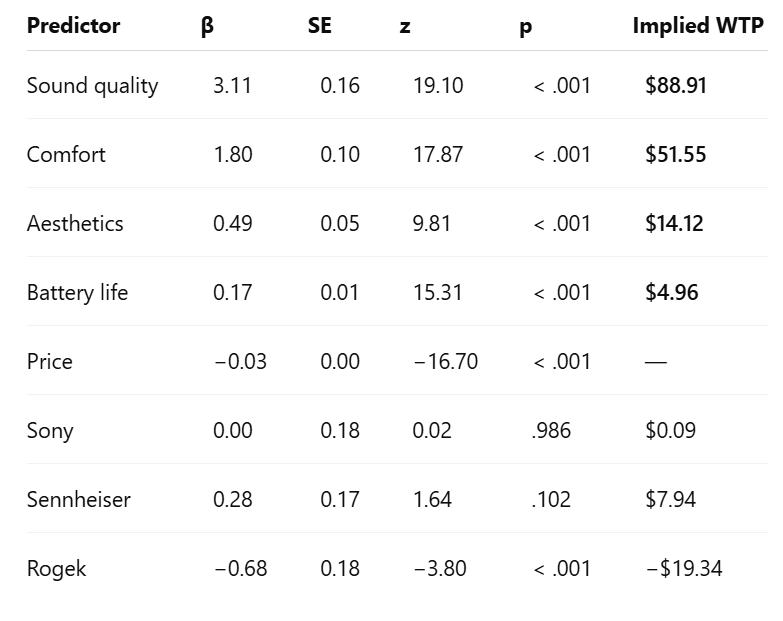
This article presents a methodological case study on consumer preference analysis in the headphone category using choice-based conjoint analysis (CBCA) and SPSS software. The analysis translates product attributes—such as brand, price, noise cancellation, and sound quality—into quantifiable preference utilities and willingness-to-pay estimates. While the technique itself has relevance for product development and pricing strategies, the piece is fundamentally an academic/technical tutorial rather than market-moving research.
The conjoint framework reveals how consumers trade off competing product attributes when making purchase decisions. Understanding preference utilities enables manufacturers to optimize product portfolios and identify price elasticity for differentiated features. However, this remains a backward-looking analytical exercise rather than forward-looking market intelligence or earnings-relevant disclosure.
Consumer electronics manufacturers, including companies like SONY and other audio hardware producers, routinely employ similar analytical methods internally for product positioning and NPD strategies. Public disclosure of such consumer research insights is rare and typically proprietary, limiting direct investment applicability from academic treatments.
Sector implication: The article reinforces that consumer discretionary spending in electronics hinges on feature-benefit perception and value proposition. However, absent any specific product launch, earnings forecast revision, or competitive intelligence, this remains a low-conviction signal for broad technology or consumer cyclical positioning.