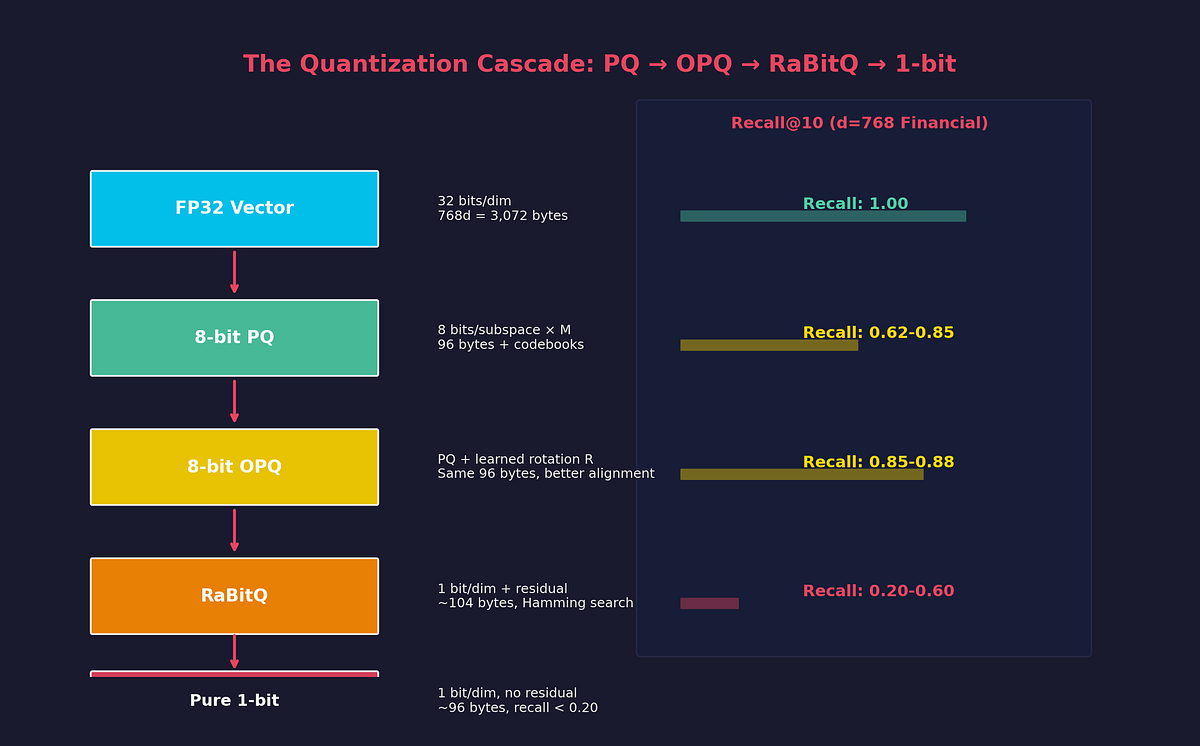
This article examines technical limitations in quantization methods used in machine learning model compression, specifically how reducing bit-depth from standard floating-point to 8-bit representations creates cascading performance degradation. The focus on quantization cascades (PQ → OPQ → RaBitQ → 1-bit) highlights a fundamental trade-off in AI infrastructure: reducing computational overhead while maintaining data fidelity.
The recall collapse phenomenon referenced indicates that aggressive quantization degrades the quality of vector embeddings—the numerical representations used in financial data processing, search, and recommendation systems. This technical constraint is relevant to firms deploying large-scale ML inference, where inference cost directly impacts operational margins and model accuracy.
For financial embeddings specifically, the implications extend to algorithmic trading, fraud detection, and portfolio analytics systems that rely on embedding-based nearest-neighbor search. The degradation pattern suggests that extreme compression may not be suitable for precision-critical financial applications, creating a potential market for specialized hardware and optimized quantization frameworks.
Sector implication: This is primarily an academic/technical deep-dive with minimal near-term market impact. It affects edge computing and AI infrastructure vendors indirectly, but does not represent earnings-moving news or material strategic shifts for major technology companies. Relevance is confined to specialized ML infrastructure and research communities rather than institutional investors.